Authority Is the New Perimeter: Crittora's Response to Anthropic's Emerging Agent Security Model
Crittora Editorial
Apr 20, 2026
Tags:
TL;DR
A thought-leadership response from Crittora on Anthropic's emerging agent security direction, why structured tool use is not enough, and why agentic AI needs an explicit authority layer.
Key Takeaways
- A thought-leadership response from Crittora on Anthropic's emerging agent security direction, why structured tool use is not enough, and why agentic AI needs an explicit authority layer.
- Field note by Crittora Editorial, published Apr 20, 2026.
- Topics covered: agent security, Anthropic, MCP, AI governance.
Quick Answers
What is this article about?
A thought-leadership response from Crittora on Anthropic's emerging agent security direction, why structured tool use is not enough, and why agentic AI needs an explicit authority layer.
Who published this and when?
Crittora Editorial published this field note on Apr 20, 2026.
Is this available in multiple languages?
Yes. This page is the English version. A Spanish version is available at /es/field-notes/authority-is-the-new-perimeter-response-to-anthropic-agent-security.
Authority Is the New Perimeter: Crittora’s Response to Anthropic’s Emerging Agent Security Model
The industry is finally converging on the right problem.
As AI systems evolve from passive assistants into active agents, the question is no longer just what models can generate. It is what they are allowed to do.
That shift matters.
Across the agent ecosystem, the conversation has moved beyond prompt quality and model capability into something much more operational: tool access, execution boundaries, runtime trust, and control at the moment an agent acts.
Anthropic deserves credit for helping move that conversation forward.
Its work around safer AI systems, steerability, and the Model Context Protocol has helped define a cleaner interface layer for how models connect to tools and external systems. That is meaningful progress. But it also exposes the deeper issue the industry still has not fully solved.
Agent security is not fundamentally a model problem. It is an authority problem.
Related Crittora resources: Crittora Authority Broker demo, ambient authority explainer, and Agent Permission Protocol whitepaper.
What Anthropic Gets Right
Anthropic has consistently framed its mission around building reliable, interpretable, and steerable AI systems. It also introduced the Model Context Protocol as an open standard for connecting AI applications to tools and data sources more cleanly and consistently.
That matters because the developer world has already crossed into an environment where agents can connect to hundreds or even thousands of tools, data sources, and workflows. As those connections scale, so does the attack surface.
Anthropic’s framing helps the market in three important ways:
- It acknowledges that agents are no longer just answering questions. They are increasingly taking action.
- It treats tool use and context access as architecture problems, not just UX features.
- It recognizes that a secure agent stack needs structure around external system access.
That is real progress.
But Structure Alone Does Not Equal Security
The problem is that structured tool access is still not the same thing as explicit authority.
A protocol can define how tools are described. A runtime can define how they are connected. A model can decide when to use them.
But none of that, by itself, answers the most important question:
What is this agent actually authorized to do right now?
That is where many current approaches still break down.
If tools are mounted in an environment and the agent can reach them, the system often treats availability as permission. In practice, that creates ambient authority:
- tools exist before authorization is verified
- access persists beyond the task that justified it
- permissions are inherited from the environment rather than granted for the moment
- enforcement depends too heavily on the model behaving as instructed
That is not a stable security boundary. It is an assumption.
What the Market Is Really Saying
The clearest voice-of-customer signal in the developer and security world is not subtle anymore.
Teams are asking:
- How do we know what an agent can actually do at runtime?
- How do we prevent tool overexposure?
- How do we bind permissions to a specific task, actor, and time window?
- How do we stop replay, confused deputy behavior, or silent privilege creep?
- How do we prove, after the fact, why a state-changing action was allowed?
These are not edge questions from advanced research labs. They are operational questions from builders trying to move agentic systems into production.
And they all point to the same gap:
The ecosystem has interfaces for tools, but it still lacks a standard authority layer for execution.
Crittora’s Position: Authority Must Become a First-Class Object
At Crittora, we believe the industry is correctly identifying the symptoms but still underspecifying the cure.
The missing layer is not another prompt strategy. It is not stronger policy language inside model instructions. It is not a more elegant tool manifest.
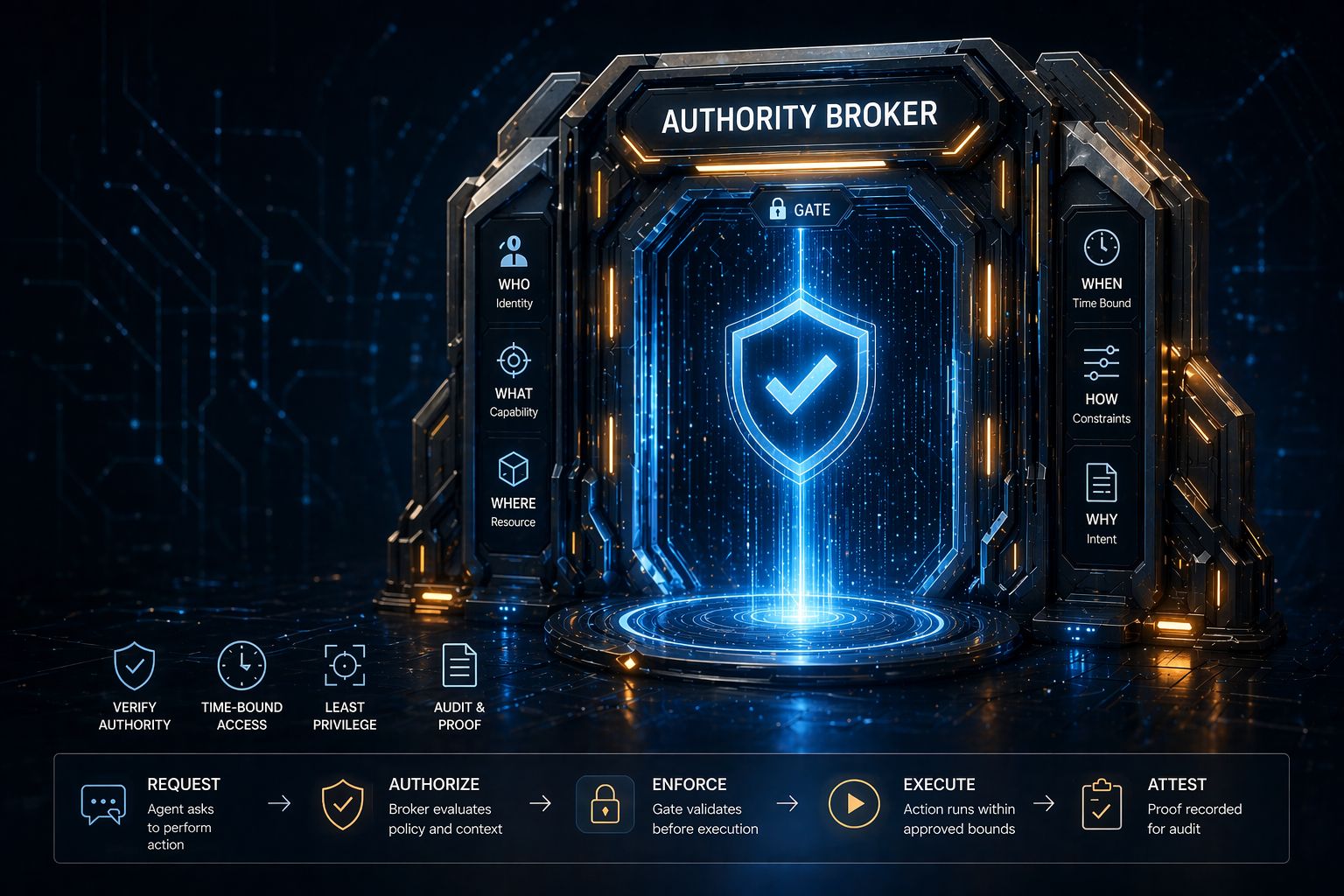
It is explicit, verifiable, time-bound authority enforced before execution begins.
That is the thesis behind the Agent Permission Protocol and the Crittora Agent Authority Broker.
Our view is simple:
- intelligence should propose
- authority should decide
- execution should only occur after permission is verified
This is the separation that agentic systems need if they are going to scale safely.
From Ambient Access to Bounded Capability
Today, many agent stacks still work like this:
- give the model tool access
- provide guidance about when it should or should not use those tools
- monitor outputs afterward
- hope the guardrails hold
That approach does not create a hard control boundary.
The shift we need is this:
Old model
Tools are available, so the agent can try to use them.
Required model
Capabilities are granted explicitly for a specific action, audience, scope, and time window.
That means moving from:
- implicit trust to explicit authorization
- persistent access to ephemeral access
- behavioral compliance to runtime enforcement
- post-hoc detection to pre-execution gating
The Missing Layer: Execution-Time Authority
Anthropic has helped define an important interface layer for agents and tools.
Crittora is focused on the enforcement layer underneath it.
That layer is where authority must be bound, verified, and constrained before an action-capable runtime ever exposes tools.
In practical terms, that means:
1. Just-in-time authority
Agents should never hold broad, long-lived access. Authority should be granted for a specific action, tool, and execution step.
2. Runtime checkpoints
Every meaningful state-changing action should pass a mandatory enforcement gate before anything commits.
3. Signed, portable proof
Every approved action should leave behind a durable record tying together identity, intent, policy, and request context.
4. Deny-by-default capability exposure
If a tool is not explicitly authorized for the task, it should not exist in the execution surface.
5. Time-bound scope
Authority should expire by default, preventing silent reuse and reducing blast radius.
This is what an authority broker is for.
Not to tell the model how to think. To define what the system will permit.
Why This Matters Right Now
This is not theoretical anymore.
Anthropic’s own model and safety materials increasingly reflect the reality that frontier systems are becoming more capable at tool use, agentic workflows, and sustained autonomous execution. As those capabilities increase, the cost of ambiguous authority grows with them.
The industry is entering the execution era of AI.
And in the execution era, the core risk is not that a model says the wrong thing. It is that a model, agent, or orchestration layer can do the wrong thing with real systems.
Without a dedicated authority layer:
- every tool connection can become an unintended permission grant
- every runtime can become a confused deputy
- every reusable instruction can become replayable authority
- every production deployment inherits hidden risk from ambient access
The Stack Is Splitting Into Three Layers
We believe the market is converging toward a three-layer architecture:
1. Intelligence Layer
This is where reasoning, planning, generation, and decision support happen.
2. Interface Layer
This is where protocols like MCP define how tools, data, and context are connected to models.
3. Authority Layer
This is the missing control plane that determines what the agent is actually allowed to do, under what constraints, and for how long.
Anthropic is helping move the industry forward on the interface layer.
Crittora is focused on the authority layer.
Both matter. But they are not the same thing.
The Real Opportunity: Standardizing Agent Authority
The market eventually standardizes whatever becomes indispensable.
TLS standardized secure transport. OAuth standardized delegated identity. MCP is helping standardize tool and context interoperability.
The next standard the ecosystem needs is explicit authority for agents.
Not vendor-specific. Not hidden in prompts. Not implied by available tools. Not dependent on model obedience.
But explicit. Portable. Verifiable. Time-bound. Enforceable at runtime.
That is the path from impressive demos to trustworthy production systems.
Final Thought
This is not about restricting innovation.
It is about making agentic execution trustworthy enough to deserve adoption at scale.
Anthropic is helping define how agents connect. That is important.
But the next step is defining who gets to act, under what bounds, and with what proof.
Because once an agent can touch real systems, the perimeter is no longer the network.
Authority is the new perimeter.
About Crittora
Crittora builds the authority layer for agentic systems.
Through the Agent Authority Broker and the Agent Permission Protocol, Crittora helps organizations verify and govern what agents can do before automated actions touch real tools, APIs, and systems of record.
If you are building agentic workflows and need runtime control, bounded permissions, and proof after every action, Crittora is building for that future.