Fannie Mae's New Security Supplement Makes AI Governance a Security-Program Requirement
Crittora Editorial
Oct 23, 2026
Tags:
TL;DR
The 2026 Fannie Mae Information Security and Business Resiliency Supplement adds Super Intelligence governance, covers document custodians and integrators, holds Companies responsible for vendor AI, and sets a 36-hour incident-notice standard. What mortgage companies should do before January 18, 2027.
Key Takeaways
- The 2026 Fannie Mae Information Security and Business Resiliency Supplement adds Super Intelligence governance, covers document custodians and integrators, holds Companies responsible for vendor AI, and sets a 36-hour incident-notice standard. What mortgage companies should do before January 18, 2027.
- Field note by Crittora Editorial, published Oct 23, 2026.
- Topics covered: Fannie Mae, Super Intelligence, AI governance, mortgage security.
Quick Answers
What is this article about?
The 2026 Fannie Mae Information Security and Business Resiliency Supplement adds Super Intelligence governance, covers document custodians and integrators, holds Companies responsible for vendor AI, and sets a 36-hour incident-notice standard. What mortgage companies should do before January 18, 2027.
Who published this and when?
Crittora Editorial published this field note on Oct 23, 2026.
Is this available in multiple languages?
Yes. This page is the English version. A Spanish version is available at /es/field-notes/fannie-mae-security-supplement-super-intelligence-governance.
Fannie Mae’s New Security Supplement Makes AI Governance a Security-Program Requirement
Fannie Mae has published an updated Information Security and Business Resiliency Supplement. The new edition is effective January 18, 2027, and Fannie Mae is encouraging companies to adopt the requirements now, not at the deadline.
Tucked inside is a section the mortgage industry will be working through for a while: Super Intelligence governance.
If you use AI anywhere near Fannie Mae loans, read it before the new year. It runs 28 pages. What follows is the part AI teams can act on.
First, the name: “Super Intelligence” is not what you think
The Supplement uses “Super Intelligence,” or SI, where previous documents said “artificial intelligence.”
Before anyone panics: Fannie Mae states the change “is not intended to alter the scope, meaning, or applicability of the requirements.” It is a terminology update, not a new category of machine. Your AI governance obligations are now your SI governance obligations. Same substance, new label.
Expect confusion in the market anyway. Budget time to explain it to your board.
Who “Company” means now
The Supplement’s definition of Company includes Single-Family lenders, Multifamily lenders, document custodians, and integrators, which Fannie Mae also calls third-party solution providers.
Read that again if you are a mortgage technology vendor. This is not only a lender document. If your product touches Fannie Mae work and uses AI, the requirements point at you directly, and separately, your lender customers have to answer for you anyway (more on that below).
An affiliate can perform obligations on the Company’s behalf. That delegates the work, not the responsibility.
What Section 4 actually requires
The SI governance program is the core of the update. Each Company using SI in Fannie Mae work must implement a documented governance program that includes:
- an inventory of SI use cases, with processes to detect, track, and measure their purpose and scope
- risk identification, assessment, and alignment to the Company’s risk tolerance
- data governance, retention, classification, and quality standards
- governance of model design, training, testing, and validation
- monitoring, auditing, ongoing oversight, and performance assessment, including post-deployment monitoring and retirement
- change management controls for SI models, systems, and use cases
- security-risk assessment covering adversarial manipulation, model inversion, data leakage, prompt injection, and training-data integrity
- documented safeguards for data protection, model integrity, and misuse
- segregation of duties for the people who map, measure, and manage SI risk
- governance of third-party SI use that is no less protective than your own
Plus a designated owner, review at least annually, and prompt disclosure to Fannie Mae on request: the types of SI used, the purpose and manner of use, and the safeguards implemented.
Two things stand out.
This is a security standard, not a policy suggestion. Inventory, monitoring, change control, segregation of duties, prompt injection. That list could have come from a security framework, and the Supplement asks your broader program to align with NIST 800-53 or ISO 27001. Treat your SI program as part of your security program, because Fannie Mae does.
SI outputs count as Confidential Information. The Supplement says outputs derived from Confidential Information should be treated as Confidential Information. That has teeth for AI tooling: every place your AI touches Fannie Mae data, including logs, captures, and caches, inherits the protection requirements.
The vendor paragraph changes procurement
Section 3.14 requires Companies to cause their third parties to comply with the Supplement, with information security, SI, and resiliency controls that meet or exceed its requirements. Then comes the sentence that belongs framed in every vendor-management office:
“Company is responsible for all failures by such a third party to comply with this Supplement to the same extent as if such failure were committed by the Company.”
Your LOS vendor’s new AI feature is now your responsibility. Your document-review provider’s model pipeline is your incident surface. A questionnaire records a representation; it does not govern an agent. You need a way to control what vendor AI actually does inside your perimeter, and evidence you hold yourself.
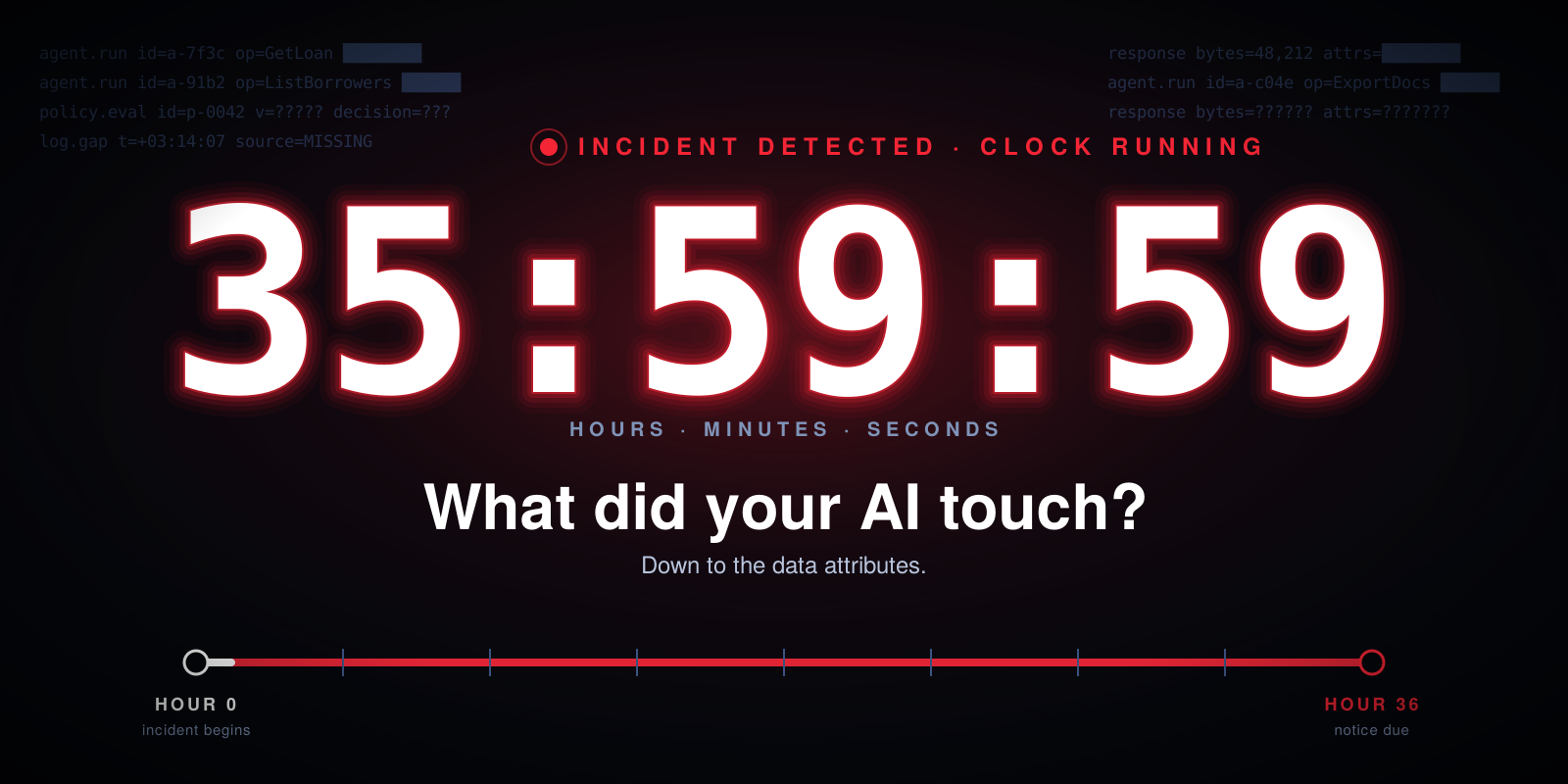
36 hours, down to data attributes
If a Cybersecurity Incident occurs, including at a third party, the Company must notify Fannie Mae without undue delay and no later than 36 hours after identification. The notice must include all known details, and when available, whether and to what extent, “including the data attributes of,” Fannie Mae Confidential Information was accessed, taken, or exposed.
Down to data attributes.
Now ask the uncomfortable question: if an AI agent was in the blast radius, could you answer that in 36 hours?
Which agents ran? What did each one call? Which loan records did they touch, and what exactly came back to the model? For most teams that is a forensic project, not a query. The clock spends itself while someone reconstructs calls from scattered logs.
For AI-agent activity, those answers live in per-call records: the intent, the decision, the outcome, the response traffic. If those records do not exist at the point of action, the 36-hour notice becomes archaeology.
What to do before January 18, 2027
Fannie Mae encourages adoption now. A practical sequence for the weeks between now and the deadline:
- Inventory. List every AI and SI use case touching Fannie Mae work, including features embedded in vendor products. Everything else builds on this list.
- Map the security overlay. For each use case, note where it can touch Confidential Information and where SI outputs get stored.
- Vendor pass. Identify third parties whose systems or agents touch Fannie Mae data. Ask what AI they run and how it is safeguarded. Decide how you will govern it, not just record it.
- Evidence plan. For the highest-risk workflows, decide what you would show if Fannie Mae asked: what was authorized, what ran, what was denied, what was returned.
- Incident runbook. Write the 36-hour playbook for an AI-involved incident, and test who can pull each answer, from which system, in which order.
None of this is legal advice. Read the Supplement itself, and have counsel confirm applicability to your contracts.
Where Crittora fits, and where we don’t
Our focus is the point where AI touches loan data: whether an AI-enabled system had scoped authority before it called a tool, an API, or a system of record, and what evidence remains afterward.
Against this Supplement, that work shows up in specific places. Signed, versioned policy with a rollback path supports the change-management and safeguards requirements. Unique identities for people and machines, with least privilege scoped down to specific operations and records, support access management. Per-call audit records of allowed and denied actions support audit and accountability. Captured request and response traffic is what makes “what did the agent touch?” answerable inside 36 hours. And routing vendor agents through your own identity and policy layer is a concrete way to govern third-party SI use rather than merely documenting it. That is the design intent behind our Agent Authority Broker and the execution-control work we build for mortgage.
The limits matter just as much. No product makes you compliant with this Supplement. Most of it, including training, physical security, insurance, the designated owner, and the annual officer attestation, is organizational work that belongs to you. Model design and validation are yours too. We build execution controls and evidence; the program is yours to run.
That honest split is also the pitch: enforce and prove your AI governance at the point where AI touches loan data.
January 18, 2027 will arrive faster than the average governance project does. If you want a read on where your AI use stands against the new requirements, schedule a free AI readiness call. No lengthy preparation is required.
Primary sources
- Fannie Mae Information Security and Business Resiliency Supplement (effective January 18, 2027)
- Fannie Mae Supplement information page
- Fannie Mae Lender Letter LL-2026-04
- MISMO FRAME announcement
About Crittora
Crittora builds the authority and evidence layer for AI agents and automated systems in regulated environments. Its products are designed to enforce what an AI-enabled system is authorized to do before a sensitive action occurs, and to retain reviewable evidence of every allowed and denied decision.
Crittora provides technology controls and operational information. It does not provide legal advice, certify compliance, or guarantee satisfaction of Fannie Mae, Freddie Mac, MISMO, or other requirements. No endorsement by Fannie Mae, Freddie Mac, or MISMO is implied.