
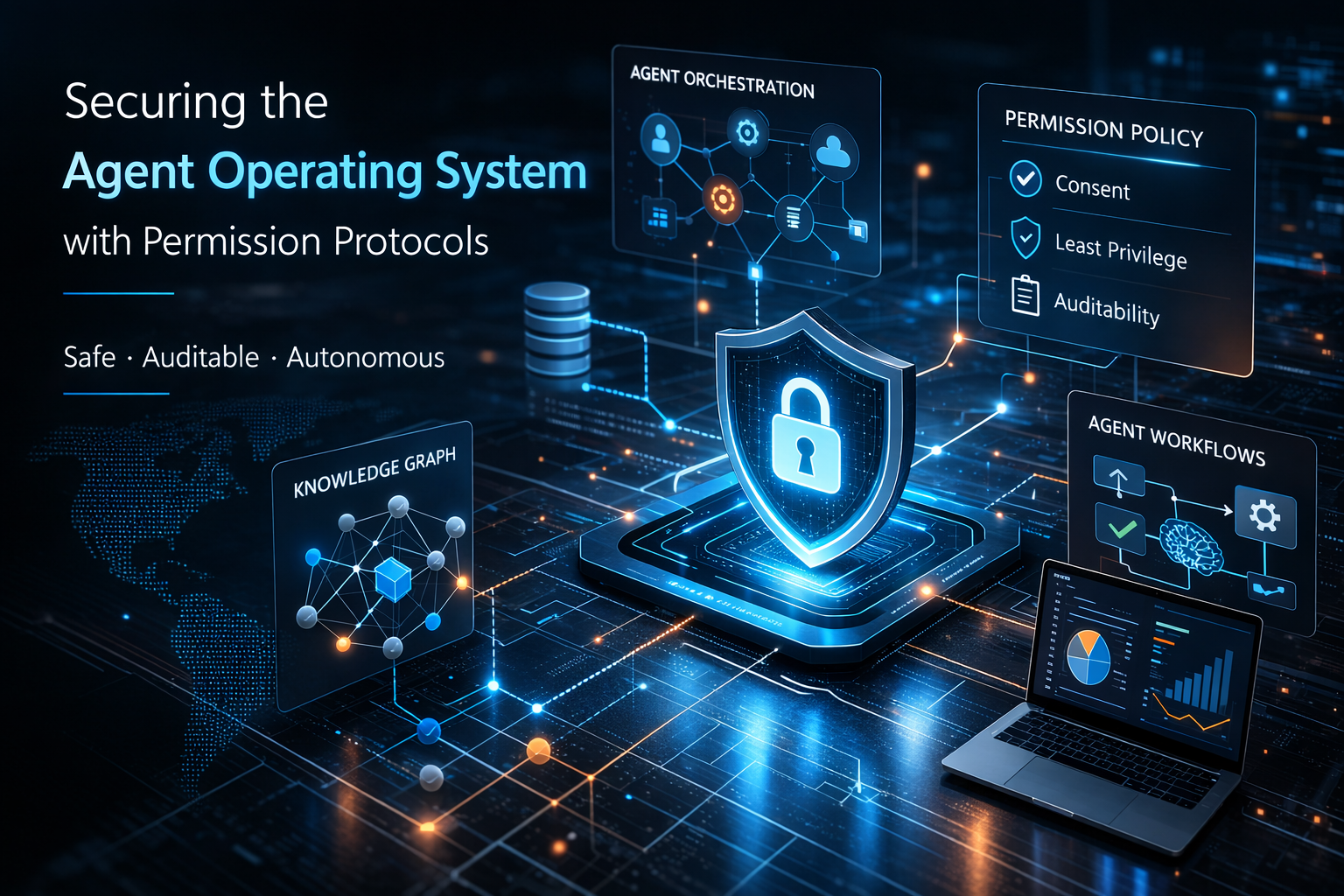
Permission Protocols for Agent Operating Systems
Crittora Research
Mar 12, 2026
Tags:
TL;DR
A research-style security analysis of AgentOS architecture, arguing that autonomous systems require deterministic authority models rather than heuristic safety layers.
Key Takeaways
- A research-style security analysis of AgentOS architecture, arguing that autonomous systems require deterministic authority models rather than heuristic safety layers.
- Field note by Crittora Research, published Mar 12, 2026.
- Topics covered: agent operating systems, permission protocols, agent security, authorization.
Quick Answers
What is this article about?
A research-style security analysis of AgentOS architecture, arguing that autonomous systems require deterministic authority models rather than heuristic safety layers.
Who published this and when?
Crittora Research published this field note on Mar 12, 2026.
Is this available in multiple languages?
Yes. This page is the English version. A Spanish version is available at /es/field-notes/why-agent-operating-systems-need-permission-protocols.
Permission Protocols for Agent Operating Systems
Why Autonomous AI Systems Require Deterministic Authority Models
Crittora Research
Abstract
The transition from application-centric software to agent-mediated execution changes the security basis of computing systems. In an agent setting, systems do not merely present tools to users. They interpret intent, synthesize plans, and invoke capabilities that may produce external effects. That shift requires deterministic authority models capable of constraining execution at the moment actions occur.
The AgentOS proposal described in AgentOS: From Application Silos to a Natural Language-Driven Data Ecosystem offers a useful architectural framework for this transition. Its treatment of orchestration, memory, and modular capability composition is substantial. However, the architecture remains security-incomplete because it does not define a formal execution-time permission protocol.
This article argues that intent inference is not authorization, heuristic safety layers are not hard security boundaries, and protocol interoperability is not equivalent to permission control. Safe agent systems require explicit permission protocols that separate reasoning from authority and preserve bounded, auditable execution.
1. Introduction
Software systems are moving from graphical workflows toward intent-driven execution. In the earlier model, users operated through applications with relatively explicit boundaries. In the emerging model, users express goals, and agentic runtimes interpret those goals, construct plans, and coordinate actions across tools and services.
This shift changes what must be secured. A useful agent may correctly infer what a user wants while still lacking authority to perform the inferred action. For that reason, intent prediction is not authorization. Likewise, a system may coordinate agents effectively while failing to constrain what those agents are permitted to do. Orchestration is not security.
This distinction also clarifies the limits of identity systems. Identity answers who is present. It does not answer what actions are permitted now. In an agent setting, authority must be scoped at execution time through explicit constraints such as intent binding, audience binding, time-to-live limits, and scope allowlists.
The central thesis is therefore narrow but important. AgentOS is a promising architectural direction, but it lacks a deterministic execution-time authority model. Without such a model, the runtime may be capable and adaptive while remaining insecure by construction.
2. The Architectural Promise of Agent Operating Systems
The AgentOS concept describes a runtime layer that interprets user intent and organizes execution across memory, tools, and specialized agents. It replaces application switching with coordinated task execution. The architecture includes an agent kernel to manage workflows, skill modules to encapsulate reusable capabilities, a Personal Knowledge Graph (PKG) to retain user context, a semantic firewall to screen unsafe inputs, and an LLM scheduler to allocate model resources.
This is a coherent control-plane vision for autonomous work. It promises reduced interface complexity, stronger contextual continuity, and a more unified execution model across heterogeneous systems. From a systems perspective, the architectural idea is credible.
The unresolved issue is not whether such a runtime can coordinate work. It is whether it can do so under a defensible authority model.
%%{init: {"theme":"base","themeVariables":{"background":"#0b1220","primaryColor":"#111827","primaryTextColor":"#e5eefc","primaryBorderColor":"#60a5fa","lineColor":"#7dd3fc","secondaryColor":"#0f172a","tertiaryColor":"#111827","clusterBkg":"#0f172a","clusterBorder":"#3b82f6","nodeBorder":"#60a5fa","mainBkg":"#111827","textColor":"#e5eefc","edgeLabelBackground":"#0b1220","fontFamily":"Inter, ui-sans-serif, system-ui"}}%%
flowchart LR
    U["User Intent"] --> I["Intent Parsing"]
    I --> P["Planner Agent"]
    P --> K["Personal Knowledge Graph"]
    P --> S["Skill Modules"]
    P --> A["Orchestrated Sub-Agents"]
    K --> A
    S --> A
    A --> T["Tools and External Services"]
    T --> E["Real-World Effects"]
View this diagram in full screen mode
3. The Security Problem: Autonomous Agents Collapse Traditional Assumptions
Traditional operating systems assume that consequential actions are initiated by humans or by applications operating within explicit permission boundaries. Even automated processes are typically constrained by account scopes, process isolation, or capability restrictions. Agent systems weaken those assumptions because models can initiate multi-step execution flows without direct human confirmation at the moment of action.
An agent may read private documents, invoke APIs, send messages, initiate transactions, or interact with external services. These actions are not isolated interface events. They are the result of interpreted intent coupled to tool invocation. This creates a materially different threat surface.
Prompt injection, indirect data exfiltration, privilege escalation across workflows, and unintended tool exposure are not peripheral concerns in this setting. They follow from the fact that planning and execution are mediated by probabilistic systems that can generalize across contexts without providing formal authority guarantees. The security problem is therefore not only model quality. It is delegated action under uncertainty.
4. Heuristic Safety Layers Are Not Security Boundaries
The semantic firewall proposed in the AgentOS architecture is a meaningful attempt to mitigate prompt injection, tainted inputs, and unsafe instructions. As a heuristic screening layer, it may improve robustness. As a hard security boundary, however, it is insufficiently defined.
The reason is simple. Filtering suspicious inputs does not answer the authority question. A system may classify a request as benign and still have no deterministic basis for deciding whether the requested action is permitted. Without explicit semantics for taint propagation, capability scoping, trust-boundary enforcement, and fail-closed denial, semantic filtering remains advisory.
Advisory controls are not enough when systems can trigger real-world side effects. A security boundary must be deterministic, auditable, and enforceable at execution time.
%%{init: {"theme":"base","themeVariables":{"background":"#0b1220","primaryColor":"#111827","primaryTextColor":"#e5eefc","primaryBorderColor":"#60a5fa","lineColor":"#7dd3fc","secondaryColor":"#0f172a","tertiaryColor":"#111827","clusterBkg":"#0f172a","clusterBorder":"#3b82f6","nodeBorder":"#60a5fa","mainBkg":"#111827","textColor":"#e5eefc","edgeLabelBackground":"#0b1220","fontFamily":"Inter, ui-sans-serif, system-ui"}}%%
flowchart LR
    U["Untrusted Input"] --> F["Semantic Filtering"]
    F --> D{"Decision"}
    D -->|allow| T["Tool Invocation"]
    D -->|block| B["Block"]
    R["No deterministic authority check"] -.-> T
View this diagram in full screen mode
5. Intent Inference Must Be Separated from Authority Grant
The PKG is one of the strongest elements of the AgentOS design because it improves usability under ambiguity. A request such as “book my usual flight” can be resolved more effectively if the system knows common routes, airlines, or seating preferences. That is a legitimate interface advantage.
However, contextual inference must not expand authority. A system may infer likely actions, rank candidate plans, and resolve ambiguity, but those functions do not establish permission. If personalization is allowed to influence what the system is authorized to do, then preference modeling becomes a covert mechanism for privilege expansion.
The design requirement is therefore clear: inference may shape candidate actions, but only a separate permission verification process may determine whether execution is allowed.
%%{init: {"theme":"base","themeVariables":{"background":"#0b1220","primaryColor":"#111827","primaryTextColor":"#e5eefc","primaryBorderColor":"#60a5fa","lineColor":"#7dd3fc","secondaryColor":"#0f172a","tertiaryColor":"#111827","clusterBkg":"#0f172a","clusterBorder":"#3b82f6","nodeBorder":"#60a5fa","mainBkg":"#111827","textColor":"#e5eefc","edgeLabelBackground":"#0b1220","fontFamily":"Inter, ui-sans-serif, system-ui"}}%%
flowchart LR
    U["User Request"] --> I["Intent Inference"]
    I --> C["Candidate Actions"]
    C --> V{"Permission Verification"}
    V -->|approved| E["Execution"]
    V -->|denied| H["Human Review"]
View this diagram in full screen mode
6. Multi-Agent Architectures Create Delegation Risk
Multi-agent systems improve modularity by distributing work across planner, retrieval, browsing, scheduling, and execution roles. That decomposition also introduces delegation risk. If authority propagation is not explicit and bounded, child agents may inherit privileges that exceed what is required for their local task.
This is a version of the confused deputy problem in a dynamic orchestration environment. A trusted component may act on behalf of a request whose authority has not been properly constrained. The problem is amplified by the fact that delegation chains may be deep, adaptive, and partially opaque at runtime.
Several constraints follow directly from this risk:
- Child agents should receive only the capabilities required for the delegated step.
- Delegated authority should never exceed the parent agent’s authorized scope.
- Delegation depth should be explicitly bounded.
- Each action should remain attributable to a principal, policy, and execution event.
In protocol terms, delegation must be represented rather than assumed. A parent policy should state whether delegation is allowed, how deep delegation may proceed, and whether the child scope is a strict subset of the parent scope. Without these controls, agent chains amplify authority faster than they amplify accountability.
Without such constraints, multi-agent orchestration compounds capability without preserving accountability.
7. Protocol Interoperability Is Not Authorization
Protocols such as the Model Context Protocol can improve interoperability. They can standardize tool descriptions, invocation formats, and the exchange of structured context between components. These are meaningful operational benefits.
They are not authorization mechanisms. A protocol can describe how a tool is called. It cannot, by itself, determine whether the tool should be exposed or whether the call is permitted in the current execution context. Interoperability addresses invocation structure, not authority semantics.
This distinction matters because protocol standardization may broaden access surfaces while leaving the permission problem unresolved. Secure agent systems must gate capability exposure through explicit verification rather than through protocol compliance alone.
8. What Deterministic Permission Protocols Must Provide
If autonomous systems are to act safely, they require permission protocols that operate as deterministic authority layers at execution time. Such protocols should provide explicit consent for consequential actions, least-privilege capability exposure, bounded delegation, execution-time verification, and auditability.
The key principle is separation of reasoning from authority. Models may interpret requests and synthesize plans, but permission protocols must determine whether a capability becomes available and under what conditions. If a policy is missing, invalid, expired, or out of scope, the runtime should deny or escalate rather than proceed on a best-effort basis.
This structure is necessary because tool visibility itself is part of the security surface. Capabilities should not be ambient. They should appear only after verification succeeds and only within the scope defined by the governing policy. In a stronger model, the authority unit is a cryptographically sealed permission policy: signed, protected against intermediary tampering, and time-bound so that stale authority cannot persist indefinitely.
The same model should remain capability-based rather than tool-based. Policies should grant abstract capabilities such as calendar.write or email.send, not concrete runtime method names. A capability registry can then resolve those grants into environment-specific operations while preserving policy stability across runtimes and tool renaming.
Operationally, a deterministic verifier should enforce a strict sequence before execution begins:
- Decrypt or unwrap the permission artifact if needed.
- Verify signature integrity and issuer authenticity.
- Validate required fields such as intent, audience, scope, and delegation terms.
- Enforce TTL and freshness constraints.
- Resolve allowed capabilities through a registry.
- Construct an ephemeral execution surface from the verified result.
- Permit execution and record audit evidence, or fail closed.
%%{init: {"theme":"base","themeVariables":{"background":"#0b1220","primaryColor":"#111827","primaryTextColor":"#e5eefc","primaryBorderColor":"#60a5fa","lineColor":"#7dd3fc","secondaryColor":"#0f172a","tertiaryColor":"#111827","clusterBkg":"#0f172a","clusterBorder":"#3b82f6","nodeBorder":"#60a5fa","mainBkg":"#111827","textColor":"#e5eefc","edgeLabelBackground":"#0b1220","fontFamily":"Inter, ui-sans-serif, system-ui"}}%%
flowchart LR
    U["User Request"] --> I["Intent Analysis"]
    I --> P["Candidate Plan"]
    P --> S["Policy Issuer"]
    S --> Q["Signed Permission Policy"]
    Q --> V{"Permission Policy Verification"}
    V -->|valid| R["Capability Resolution"]
    R --> C["Ephemeral Capability Surface"]
    V -->|invalid or missing| D["Escalate / Deny"]
    C --> E["Agent Execution"]
    E --> A["Audit Log"]
View this diagram in full screen mode
9. Is AgentOS Actually an Operating System?
The AgentOS label invites an architectural clarification. The proposed system does not replace the underlying operating system in the classical sense. It does not directly arbitrate hardware resources, process isolation, or kernel-level scheduling. Instead, it operates above the conventional OS as a runtime for agent coordination, memory access, and tool orchestration.
In that sense, the architecture presently resembles a secure control plane or orchestration runtime more than a classical operating system. This is not a weakness. It is a more precise description of the layer at which the system operates. That distinction matters because the security properties expected from a control plane differ from those expected from a kernel.
10. How Agent Systems Should Be Evaluated
Agent systems should not be evaluated solely through metrics such as alignment, task completion, or hallucination rate. Those measures are useful for assessing model behavior, but they do not establish whether the execution architecture is safe.
Security-specific measures are also required. At minimum, systems should be assessed using unauthorized tool exposure rate, privilege escalation incidence, delegation amplification rate, audit completeness, policy verification latency, and false allow versus false deny behavior. These metrics address whether the runtime constrains authority with sufficient precision under realistic conditions.
Evaluation should also ask whether the runtime fails closed under verifier errors, whether execution surfaces are ephemeral rather than ambient, and whether audit records are strong enough to prove which policy authorized which side effect. Those are the measures that connect model behavior to accountable system action.
Without such measures, evaluation focuses on outcome quality while leaving execution control materially underexamined.
11. Discussion
The AgentOS vision is significant because it reflects the direction of software systems toward coordinated agent execution. Its strengths lie in orchestration, durable context, and modular capability composition. These are important architectural contributions.
The missing layer is authority. The proposal does not yet specify how permissions are represented, how they propagate across agent boundaries, or how execution is constrained when plans reach systems that can produce external effects. It does not yet define cryptographic policy objects, a deterministic verifier pipeline, capability resolution, or ephemeral execution surfaces as first-class enforcement primitives. That absence is not a minor implementation detail. It is the central unresolved security problem.
An agent runtime may be intelligent and useful while still remaining insecure by construction if it relies on heuristics where deterministic authority checks are required.
12. Conclusion
Agent systems will not be judged only by how well they infer intent. They will also be judged by whether they act with precision, restraint, and accountability. That standard requires more than orchestration, memory, or protocol interoperability.
The conclusion is therefore direct. AgentOS is a promising architectural model, but safe autonomy requires deterministic execution-time permission protocols. Until authority is modeled as explicitly as intent, autonomous systems will remain operationally capable yet security-incomplete.